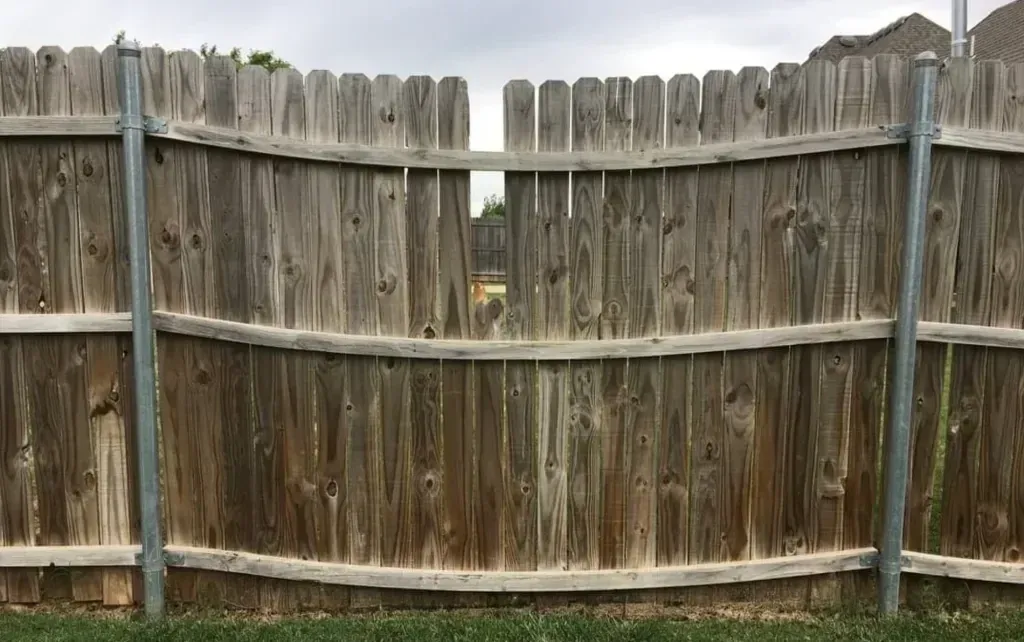
Two fence estimates can cover the same footage and land at very different prices. Most of the time the gap is in details you will not see on installation day: thinner posts, a cheaper wood species, lighter wire, or a thinner finish.
In Oklahoma City, Edmond, Yukon, and the rest of the metro, those details get tested. Wind pushes on every panel. Sun and swinging moisture work on every board. Your fence is doing that job long after the crew drives away.
Here is what we compare when we look at any fence, and what we think you should compare before you sign.
Start with the steel behind the pickets
A wood privacy fence is a wall that catches wind. The steel posts carry that load, so they are the first thing we check on a bid.
Some fences use lightweight round tubing with a .065-inch wall. Our standard round steel post for wood fencing has a .095-inch wall, and we go heavier when the project needs it.
That is 46% more steel in the wall. We are not claiming 46% more strength. We are saying it is a real difference in what holds your fence up.
"Cedar" is not one thing
If an estimate says cedar fence and nothing else, you do not yet know what you are buying. Here is how we sort the four woods we see most.
Western Red Cedar
Natural decay resistance, handsome grain, and good dimensional stability, which means it holds its shape as moisture changes.
It is still wood. Some checking, shrinking, and movement are normal. Picket thickness matters as much as species, because a thin cedar picket and a thick premium one are different products with the same name on the estimate.
Japanese Cedar
Also called sugi. It is a different species from Western Red Cedar. Budget installers often pass it off as cedar, and some go as far as labeling it "red cedar."
In our experience it beats basic pressure-treated pickets but does not replace premium Western Red Cedar. We have seen warping and boards pulling away from the runners, the horizontal rails that hold the pickets. Not every board fails, since grade, thickness, drying, and fasteners all count. Just know which cedar you are paying for.
Pine
Pine is a species. Untreated pine generally needs added protection against outdoor decay before it belongs in a fence.
Pressure-Treated
This is the worst option, and we do not recommend it. We do not install it.
Pressure treatment is a process, and most treated fence lumber is pine, so these two overlap. The preservatives help against decay and insects. They do not stop shrinking, twisting, or warping.
Wet treated boards can move a lot as they dry. Good drying and good installation help, but "pressure treated" never guarantees a straight board.
How deep the posts go
Concrete-set posts and driven posts can both give you a dependable fence when the post, soil, depth, and installation fit the job. Both fail when they are set too shallow, and concrete does not rescue a shallow hole.
For a typical six-foot wood fence, these are the starting depths we use. The rule behind them: at least half the above-ground fence height for driven posts, and one-third for concrete-set.
| Installation method | Starting minimum below ground |
|---|---|
| Driven posts | 3 ft |
| Concrete-set posts | 2 ft |
These are starting minimums, not engineering specs for every yard. Soil, wind exposure, post spacing, footing diameter, frost requirements, gates, and the post maker's instructions can all call for more depth or a different foundation.
How deep will my posts actually go, and what happens if the crew hits bad soil or rock?
Chain link: the wire and the frame
Galvanized chain link has the familiar silver look, with a zinc coating protecting the steel. Black vinyl-coated chain link adds a dark polymer finish that blends into a yard. Either can make a good fence. What decides it is the wire underneath and the framework holding it up.
Galvanized fabric: 11.5, 11, and 9 gauge
For steel wire, a lower gauge number means thicker wire.
Mesh opening size, how well the fabric is stretched, and how securely it is attached all change the finished result too.
Black fabric: finished gauge vs. steel core
Black chain link is often sold as 8- or 9-gauge finished fabric. "Finished" includes the coating, so that number alone does not tell you how thick the steel is. We install the heavier 8-gauge finished option on our black residential fences, because it resists denting and bending from everyday bumps.
What is the steel-core gauge, the finished gauge, and the coating type? A thicker coating alone does not mean stronger steel underneath.
Taller fences need bigger posts
As height goes up, the framework generally needs larger-diameter posts, heavier-wall posts, or both. Corners, ends, and gates carry different loads than line posts. Top rail, bottom tension wire, fittings, and spacing all work together. Privacy slats change the wind load, so decide on them before installation, not after.
Ornamental iron: the finish hides a lot
Most of what homeowners call ornamental iron is a manufactured steel system. Two black panels can look identical from the street while differing in steel thickness, weld quality, and rust protection.
Lower-priced imported panels are out there. Where a panel was made does not settle whether it is good. The maker's specifications, finish, and warranty are what let you compare two products fairly.
We prefer Ameristar Montage, made in Tulsa, Oklahoma. We like supporting American manufacturing, and Oklahoma manufacturing most of all, and we like working with a system that has documented specs. Montage uses galvanized steel and an E-Coat that protects the panels inside and out. That matters because rust can start inside hollow steel, where you cannot see it.
Which product line is included, how is it protected from rust, and what does the warranty cover?
Hardware and workmanship finish the job
Good materials still need good installation. Corrosion-resistant fasteners that match the material, solid rail support, sturdy gate frames, the right hinges, and properly sized gate posts all count. For vinyl and composite fencing, compare reinforcement, post spacing, room for expansion, and the manufacturer's requirements, not just how the fence looks.
A fence is one system, and one weak part sends you back for repairs somewhere else.
Bring this to your next estimate
Holding an estimate you are not sure about?
Send it to us and we will walk through it with you, no pressure.